
E1 Experimental Area
Contact Person: Domenico Doria [ domenico.doriaeli-np.ro ]
The E1 Experimental Area of ELI-NP was commissioned and set in operation in 2024 for ion acceleration experiments, and nuclear physics experiments performed using solid targets, as well as the production of secondary sources of particles by delivering extremely high intensity at focus. For the 8th Joint User Call, the system is optimized for running short focal experiments with a single 10 PW beam, while two-beam synchronization is planned to also be available in the future.
Laser parameters
| Parameters | Values | Comments |
|---|---|---|
| Laser beam diameter (FWHM) | 500 mm | Laser Beam B |
| Spherical mirror | F/3, f=1.5 m, 22.5 degree AOI | Enhanced Ag |
| Focal size (FWHM) | ~3 um | |
| Laser energy | Maximum 240 J on target | Post compression ≤ 10PW |
| Repetition rate | 1/60 Hz, single-shot | |
| Pulse width | 23 fs - 1 ps |
Experimental chamber
E1 Interaction Chamber
- Made of aluminum, the E1 interaction chamber is approximately 5 m in length x 4 m in width x 2 m in height. The laser beam optical axis is 800 mm from the optical table and 1,500 mm from the floor;
- Several optical tables are available outside the interaction chamber for diagnostics (Figure 1)
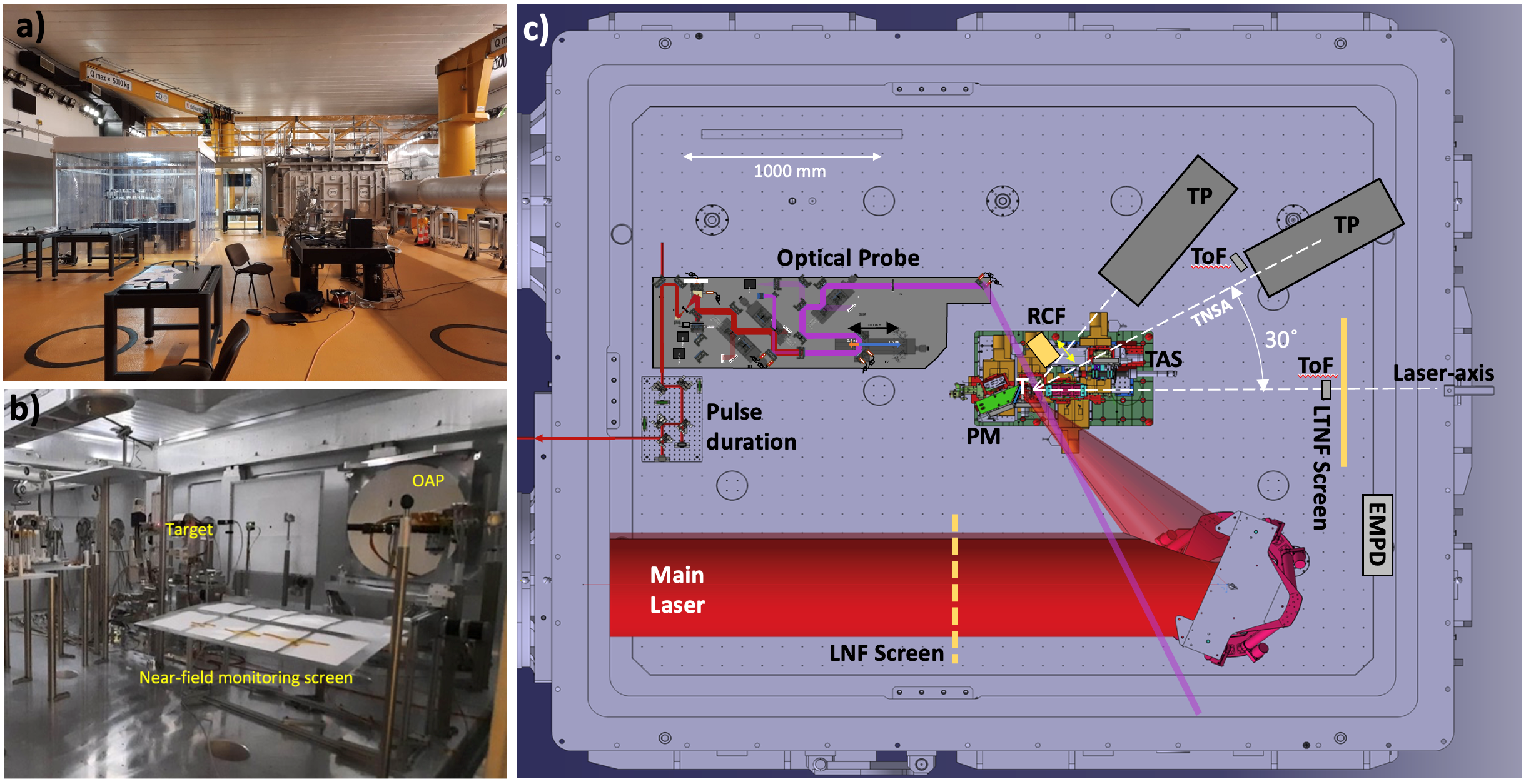
Figure 1: a) Overview of the E1 Experimental Area of ELI-NP; b) Interior of the E1 interaction chamber with the 1.5 m short focal OAP mirror; c) CAD design of a possible ion acceleration setup.
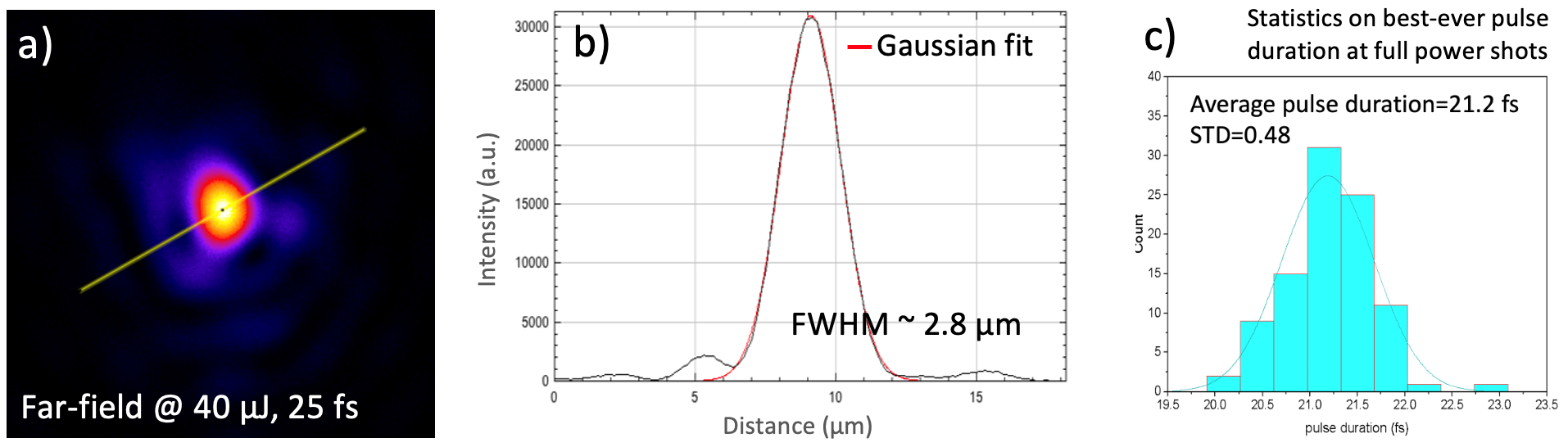
Figure 2: a) Far-field and b) laser focal spot obtained in the E1 interaction chamber; c) Typical pulse duration at full power.
Laser alignment and target manipulation
- Alignment laser: CW 800 nm (FAL laser from HPLS);
- 10x-20x objective alignment system, 1 μm spatial resolution target motion.
Laser diagnostics
- Far-field and near-field measurements at low- and full-power;
- Energy, spectrum, and pulse duration measurements (FROG) and full-power;
- Back-reflection monitor at full-power.
Particle and interaction diagnostics
- TP-Spectrometer for high-energy ions: up to 100s MeV/u;
- Radiochromic film stacks;
- Single plasma mirror (AR ~0.2%):
- Using a target foil of 100s nm, the laser interaction is usually able to generate an ~100 MeV proton cutoff;
- However, the laser contrast quality is not guaranteed, as work on improving it and removing some pre-pulses at ns and ps level is still ongoing, and therefore the final HPLS parameters may be different from the presented ones.
- Solid target wheel with 10 positions;
- Optical spectrometer: ANDOR Shamrock (VIS), UV-Vis-NIR spectrometer with optical fiber;
- Emission monitors
Triggers
- The triggers from the main laser system are available from -100 ms, then a local delay generator can be used for more precise triggers in the E1 Experimental Area (i.e. a Stanford Research Systems DG645 unit, manual available at link
Cleanroom requirements
- The E1 Experimental Area has not been officially certified as such but has a cleanliness equivalent to the ISO-8 standard, while an ISO-7 soft-wall cleanroom is also present and available for use. All of the components brought in by the users for performing their experiment must be observed by these cleanliness standards.
References
- Doria, Domenico, et al. "Overview of ELI-NP status and laser commissioning experiments with 1 PW and 10 PW class-lasers." Journal of Instrumentation 15.09 (2020): C09053
- Tanaka, K. A., et al. "Current status and highlights of the ELI-NP research program." Matter and Radiation at Extremes 5.2 (2020)